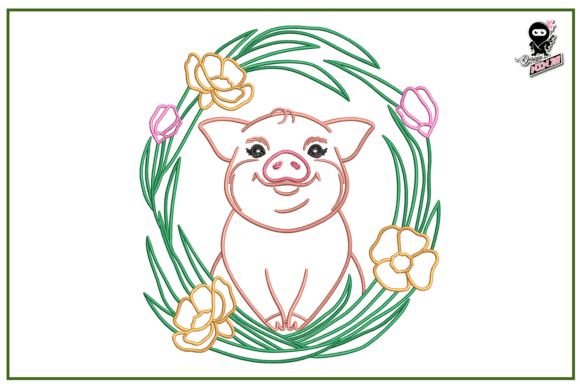
Baby Pig in Floral Wreath
First Impression: Sweet, Soft, and Instantly Recognizable
As an embroidery designer who’s prepped over 200 craft fair booths, my gut reaction to Baby Pig in Floral Wreath is immediate: it reads as gentle, joyful, and warmly nostalgic—not cutesy in a fleeting way, but timeless in its charm. It lands squarely between farmhouse sweetness and nursery elegance, with just enough floral detail to feel intentional without tipping into clutter. That balance matters: at a crowded handmade market, customers glance for under two seconds before moving on. This design stops them—not with boldness, but with soft emotional resonance. It says “thoughtful gift,” “handmade care,” and “farm-themed joy” all at once.
Where It Shines on Craft Fair Products
Tote bags: A standout. Centered on a natural canvas or oatmeal linen tote, Baby Pig in Floral Wreath reads clearly from six feet away. The wreath framing gives visual weight—no need for oversized scaling—and the pig’s round face draws the eye naturally. Perfect for baby shower gifts or farm-to-table boutique shoppers.
Aprons and tea towels: Excellent placement potential. On a denim apron pocket or the lower corner of a flour-sack tea towel, it adds personality without overwhelming utility. The floral wreath’s circular shape echoes common kitchen motifs (vintage labels, herb prints), making it feel cohesive—not tacked on.
Embroidered patches and fabric pouches: Highly effective. As a 3–4 inch patch, it holds detail beautifully and appeals to Etsy sellers curating “farm animal bundle” listings. On a drawstring pouch (especially in linen-cotton blend), it reads as premium handmade—not mass-produced.
Pillow covers and caps: Use with intention. On a 16x16 pillow cover, centered or bottom-corner, it adds quiet charm. On curved cap surfaces? Only if scaled to 2.5 inches max and tested thoroughly—tiny floral elements can distort. Avoid placing near seams or high-stretch zones unless you’ve verified stitch integrity.
What Makes It Sell—And What Requires Caution
This machine embroidery design excels in clarity and emotional appeal—but not every application is equally forgiving. Here’s what I watch for:
- Stitch density: Floral wreaths often pack fine petals and stems into tight spaces. If your embroidery file includes dense fill areas (especially around the pig’s snout or inner wreath), test on textured towels—stitch buildup can flatten detail or snag on loops.
- Small details on dark fabric: The pig’s eyes, blush, or delicate vine tendrils may vanish on navy or charcoal. Always verify thread contrast—use light ecru or pale pink top thread against deep backgrounds, and consider satin-stitch outlines for definition.
- Scale limitations: Below 2 inches wide, the pig’s facial features and floral layers risk blurring. It works beautifully as a focal point, but avoid shrinking it into a subtle border or monogram accent—it’s not built for subtlety.
- Hoop size & stabilizer needs: Without seeing exact dimensions, assume this is a mid-range hoop design (5x7" likely sufficient). But don’t skip testing: dense florals demand cutaway or tear-away + topping on knits or terrycloth. Skip stabilizer, and you’ll get puckering—not polish.
Real-World Booth & Online Impact
On my craft fair table, Baby Pig in Floral Wreath anchors a “Farm & Nursery” grouping—paired with sunflower, chick, and duck designs. Why? It creates instant category cohesion. Customers scanning for baby gifts or country-style decor lock onto it faster than isolated animals because the wreath adds context and craft intention.
For Etsy sellers and digital shops, this digital embroidery file performs strongly in listings with clean printable mockups. Its balanced composition photographs well flat or draped—no awkward cropping needed. And because it’s emotionally warm (not novelty-driven), buyers perceive higher handmade value—even when priced competitively.
It also supports brand consistency. Whether you’re selling embroidered tea towels or baby onesies, Baby Pig in Floral Wreath signals attention to detail, gentle storytelling, and curated design taste—traits that build repeat buyers across product lines.
Production Notes Every Embroidery Designer Should Run
Before cutting fabric or loading hoops, do these five things:
- Test on scrap fabric identical to your final product—especially for towels, caps, and linen blends. Note how the floral edges settle and whether the pig’s cheeks puff or flatten.
- Check thread colors against your base fabric under both daylight and booth lighting. A “soft pink” thread can look grayish under warm market tent lights.
- Review spacing between pig and wreath elements. Tight gaps risk stitching overlap; too much space weakens the unified look. Adjust if needed before batch production.
- Confirm hoop size and design footprint—don’t assume compatibility with your smallest hoop. Some wreath designs extend beyond standard 4x4 boundaries.
- Create one real finished product—not just a mockup. Drape that embroidered tote bag over your arm. Hold the pillow cover up in natural light. Does the pig feel friendly? Does the wreath feel intentional—not fussy? That tactile check separates good from great.
Final Thought: A Strategic Craft Fair Product, Not Just a Cute Design
Baby Pig in Floral Wreath isn’t just another farm animals motif—it’s a versatile, emotionally intelligent embroidery asset. It converts browsers into buyers because it solves multiple needs at once: giftability, theme cohesion, nursery warmth, and handmade authenticity. For small shop owners, it strengthens collections. For digital sellers, it boosts listing engagement. And for craft fair makers, it earns smiles, photo requests, and repeat booth visits.
Just remember: its strength lies in its soft confidence—not flash, but feeling. Honor that in your execution. Test, refine, and let the charm speak for itself.